Route 53 · September 2026
Central Route 53 outbound DNS
When VPCs need to resolve a corporate or on-premises DNS zone, each account can run its own Resolver outbound endpoint, or a network account can own one shared endpoint and share the forwarding rule with AWS RAM. With a single VPC the bill is the same; from the second VPC onward, central usually costs less because endpoints are priced per ENI-hour.
At a glance
| Pattern | Outbound endpoints (3 VPCs) | ENIs | Rule sharing | Monthly endpoint cost* |
|---|---|---|---|---|
| Per-account | 3 | 6 | None | $547.50 |
| Central | 1 | 2 | AWS RAM | $182.50 |
*ENI-hours only, at $0.125/ENI/hour × 730 hours. At one VPC both patterns are ~$182.50 — the gap opens at two. Query charges: Cost.
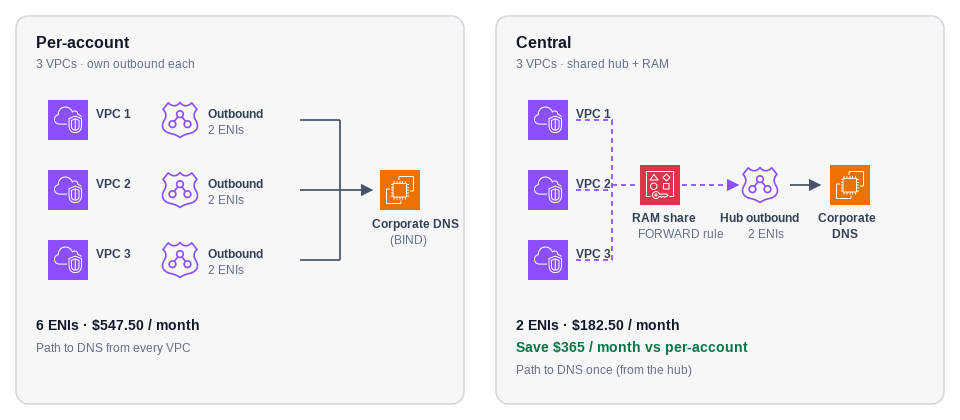
Same zone, same queries — the bill difference is mostly ENI-hours. How that gap appears as you grow: Patterns.
Why this matters
Central adds RAM you do not need for a single VPC. The second VPC is where half the ENIs — and the savings — show up.
Design How the query path worksRAM-shared FORWARD rules, hub ENIs, and why spokes need no network path to the DNS IP under central.
Cost ENI-hours are the leverEach outbound endpoint needs two ENIs at $0.125/hour. Three accounts pay for six; a hub pays for two — same query volume either way.
Demo Apply, dig, tear downThree accounts (network, dev, sandbox) in ap-southeast-2. BIND serves corp.demo.internal (and reverse); apply central, dig A + PTR, tear down.
What this does not do
- Cover Route 53 Profiles. Profiles suit complex corporate DNS sharing, but they add their own hourly cost — out of scope here; this demo uses classic Resolver rules + RAM.
- Build multi-region. Comparison is one region; production central still needs a hub per region (noted in Cost).
- Include Resolver DNS Firewall. Filtering and managed domain lists are a separate cost and control plane — out of scope.
Contents
- Patterns — one VPC vs two+, when central pays off
- Design — request path, RAM behaviour, regional scope, chargeback
- Cost — assumptions, formula, scaling table, demo overhead
- Demo — phased apply, dig checks, teardown
- References — AWS docs and posts this site builds on
Relation to AWS documentation
Builds on the Route 53 Resolver
guide and pricing with a
multi-account cost comparison and a runnable demo under terraform/accounts/.
Full source list: References.