Patterns
Same job: resolve a corporate zone (corp.demo.internal) from your VPCs.
Two shapes — per-account (each VPC owns an outbound endpoint) or central (one hub in the network account; FORWARD rule shared with RAM).
The question is not which diagram is prettier. It is when central earns the complexity.
1 · One VPC — no win yet
Stand up an outbound endpoint (two ENIs), point a rule at corporate DNS, done. That is per-account — and for a single VPC it is the whole design.
Central can do the same work, but you still pay for two ENIs and you add a shareable rule plus RAM for one consumer. Same $182.50/month. Ceremony you do not use.
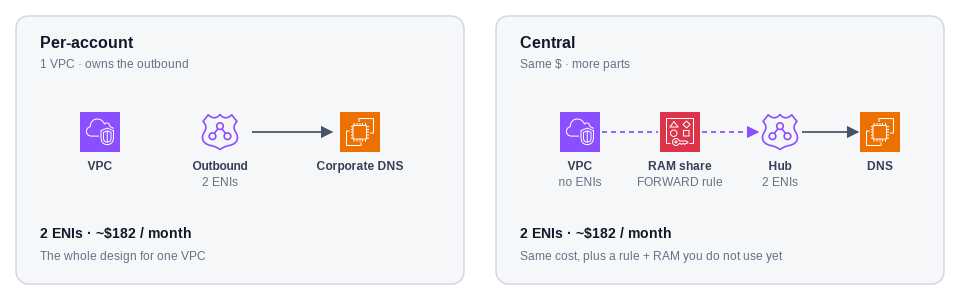
One VPC, same $182.50/month either way — central just adds a rule and RAM you do not use yet.
Prefer per-account. Central is not cheaper yet — it is a standalone resolver with extras bolted on.
2 · Two VPCs — benefit starts
The second VPC that needs the same zone is the break-even.
Per-account adds another endpoint → four ENIs, $365/month.
Central still has two ENIs, $182.50/month — the new VPC only associates the shared rule.
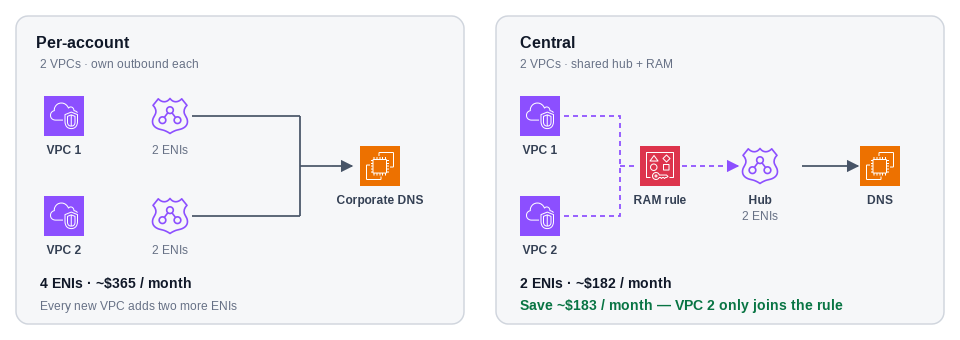
The second VPC is break-even: per-account doubles to four ENIs while central stays at two — about $182.50/month saved.
That is when the RAM you introduced starts to pay for itself.
3 · Many VPCs — the gap widens
Each extra VPC (same region, same zones) adds $182.50/month on per-account and ~$0 on central. Extra domains are extra FORWARD rules on the same endpoint — they do not multiply ENIs (see Design → One endpoint, many domains).
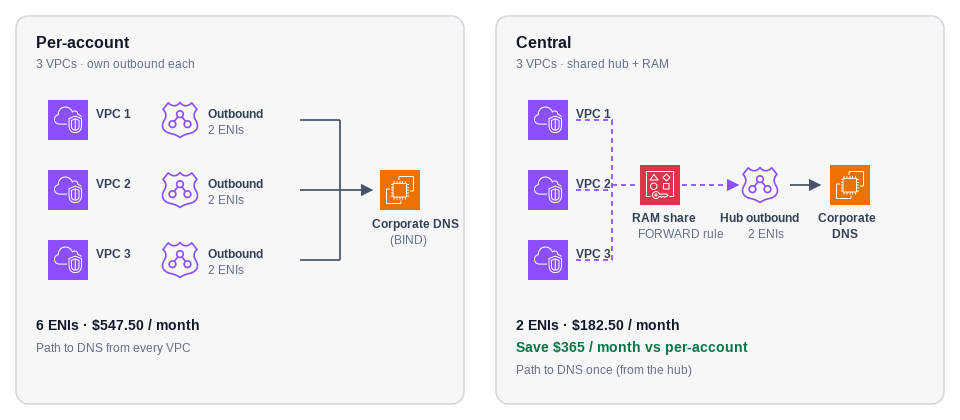
Same diagram as Overview — three VPCs is where the Overview table lands.
| VPCs | Per-account | Central | You save | Where you are |
|---|---|---|---|---|
| 1 | $182.50 | $182.50 | $0 | no win yet |
| 2 | $365.00 | $182.50 | $182.50 | benefit starts |
| 3 | $547.50 | $182.50 | $365.00 | diagram above |
| 10 | $1,825.00 | $182.50 | $1,642.50 | gap keeps widening |
Full assumptions and query bands: Cost.
4 · Cost is not the only tradeoff
Central halves ENIs from the second VPC on — and concentrates the data plane.
Blast radius
Every associated spoke forwards through the same hub endpoint and shared rules. A bad rule change, endpoint outage, or network-account misconfig can break resolution for all of them at once. Per-account keeps that failure domain inside one account: one VPC’s outbound problem does not take down another’s.
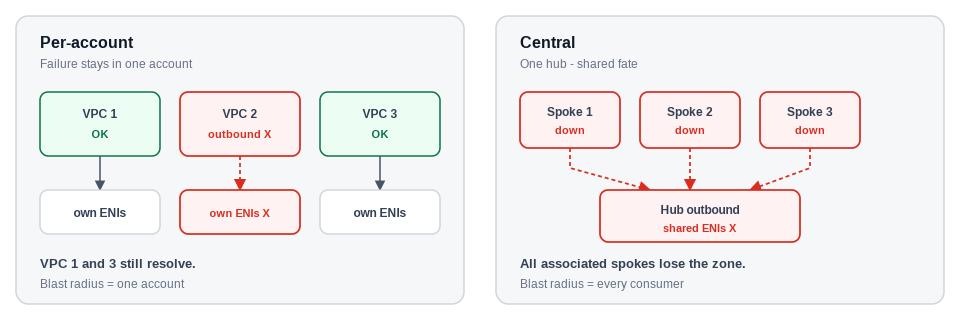
Same zone, different failure domains — per-account contains the outage; central shares it.
Hardening the hub (extra ENIs across AZs, multiple DNS target IPs) reduces AZ and on-prem DNS risk — it does not remove shared config fate. Profiles package DNS config; they are not a second live outbound data plane for the same shared rule.
Escape hatch (central + a little per-account)
Most VPCs stay on the shared hub rule. A few critical accounts keep their own outbound endpoint and a more specific FORWARD rule for the names they cannot afford to lose with everyone else.
Resolver picks the most specific domain name
when several rules match. So a spoke rule for payments.corp.demo.internal wins over
the shared corp.demo.internal rule for that name — traffic for that slice uses the
spoke’s ENIs and path to DNS, not the hub. Everything else on that VPC can still use
the shared rule.
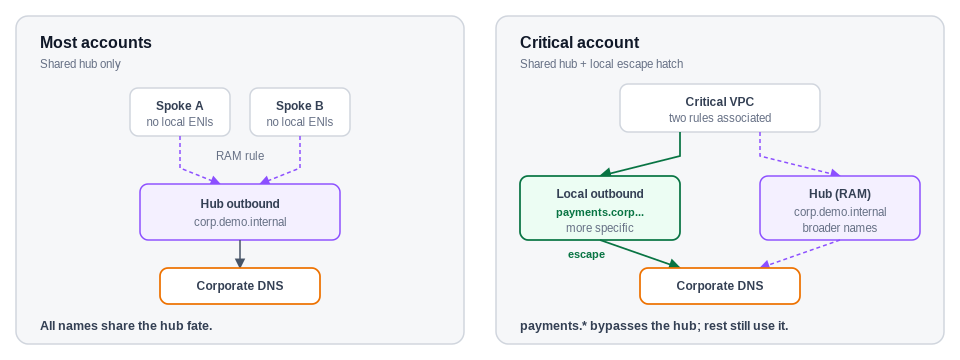
Green path = more-specific local rule (escape hatch). Purple = shared hub rule for everything else on that VPC.
| Piece | Typical choice |
|---|---|
| Most accounts / broad zone | Shared hub rule via RAM |
| Critical subdomain or account | Local outbound + more-specific rule |
| Path to DNS for the escape hatch | That account still needs TGW / VPN / peering |
You pay ~$182/month per escape-hatch endpoint (two ENIs). Use it sparingly — a few critical slices, not every VPC — or you recreate per-account cost. Design already shows the precedence beat: Rule precedence.
Who pays and who owns the plane
Query and ENI charges land on the endpoint owner — under central, the network account. Spokes look “free” for that traffic; if you need per-account chargeback, you invent it yourself (or stay per-account).
Spokes only associate the shared rule. They cannot resize, replace, or debug the hub ENIs without the network team. That is the ops cost of the savings.
Path to DNS
Per-account’s downside cuts the other way: each VPC still needs a network path to the DNS IP (TGW, VPN, or peering). Central pays that path once at the hub; spokes need no peering for resolution.
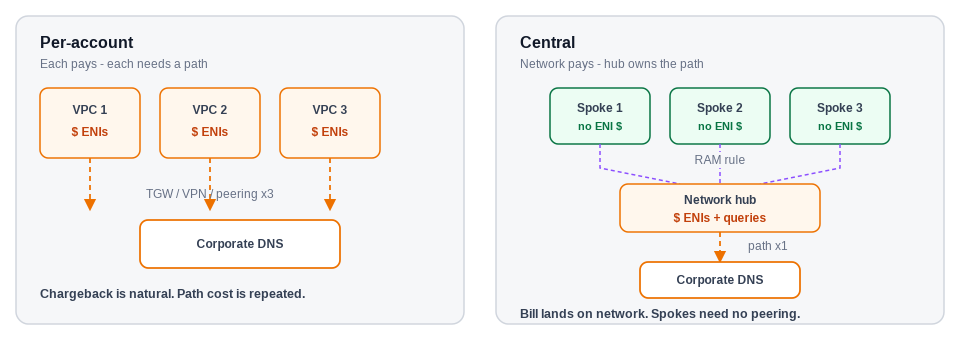
Orange dashed lines are the network path to the DNS IP — repeated per VPC on the left, once at the hub on the right.
| Factor | Per-account | Central |
|---|---|---|
| Blast radius | One account | All associated spokes |
| Chargeback | Each account pays its ENIs / queries | Network pays hub ENIs / queries |
| Ops ownership | Each account | Network account |
| Path to DNS IP | Every VPC | Hub once |
Takeaway
| Situation | Choose |
|---|---|
| One VPC | Per-account |
| Two or more VPCs, same region and zones, cost matters, shared blast radius is OK | Central |
| Mostly central, a few critical names/accounts need their own failure domain | Central + escape hatch (local outbound + more-specific rule) |
| Isolation, independent failure domains, or per-account chargeback first | Per-account |
| Multi-region | Hub (or endpoints) per region — central does not cross regions |
How the query moves once you pick: Design.
Numbers behind the table: Cost.
Run the lab: Demo.
Sources: References.