Design
Outbound DNS forwarding sends VPC queries for a chosen domain to one or more target IPs (here, a BIND server in the network account that stands in for corporate DNS).
Request path
Central
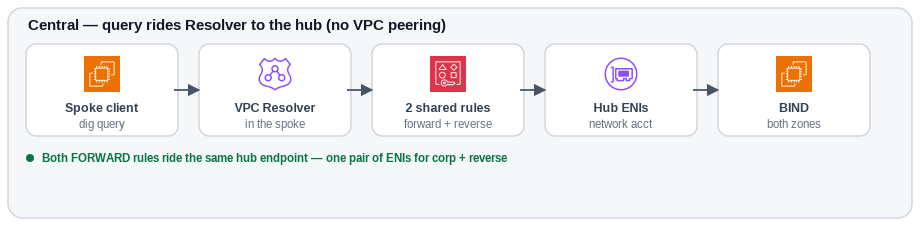
Resolver in the spoke VPC selects a shared rule and forwards through the hub endpoint. Both the forward and reverse rules use the same pair of hub ENIs. No VPC peering is required for resolution — the query never leaves Resolver's own path to the hub.
- The spoke VPC associates a FORWARD rule shared from the network account via AWS RAM.
- Route 53 Resolver in the spoke matches
corp.demo.internaland sends the query to the network outbound endpoint. - The hub endpoint (ENIs in the network VPC) queries BIND on UDP/TCP 53.
- BIND answers authoritatively. Recursion is off.
The network VPC also associates the same rule so its own test client uses the identical path.
Per-account
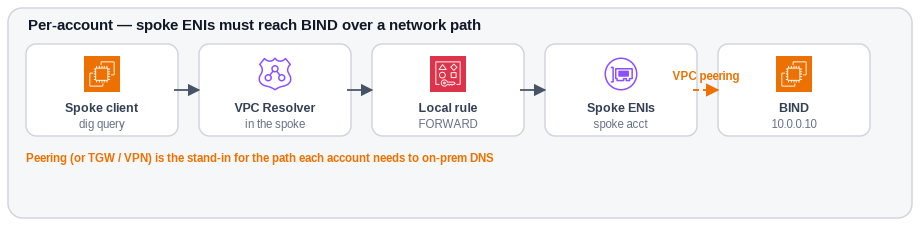
Each account owns an outbound endpoint. The last hop (orange) needs a network path: peering stands in for the TGW or VPN each account would use to reach on-premises DNS. The public demo walkthrough is central-only; enable this path via outbound_pattern = "per-account" in Terraform (see Demo / terraform/README.md).
- Each account creates its own outbound endpoint and FORWARD rule targeting the BIND IP.
- Spoke outbound ENIs must reach
10.0.0.10in the network VPC — via VPC peering when you run the per-account Terraform path. - Network accepts peering, adds return routes, and opens BIND security group ingress from spoke CIDRs.
RAM sharing
| Environment | Behaviour |
|---|---|
| AWS Organization with RAM org sharing enabled | Shares auto-accept. Do not create an accepter resource (it fails). |
| Standalone accounts / no org auto-accept | Set ram_share_accept_required = true and pass ram_share_arn so the spoke stack accepts the invitation. |
Only the rule is shared. The outbound endpoint stays in the network account. Query charges for traffic through that endpoint land on the endpoint owner (network) — a chargeback consideration.
One endpoint, many domains
The endpoint is the data plane (ENIs). Each FORWARD rule is a domain → target-IP mapping that selects an endpoint. AWS configures outbound forwarding as an outbound endpoint and one or more rules.
| What you add | What you create |
|---|---|
| Second corporate zone (same path to DNS) | Another rule on the same hub endpoint |
Reverse lookups (in-addr.arpa) |
Another rule on the same hub endpoint |
| Second VPC that needs those zones | Associate the existing rule(s) (central) |
A second domain does not require a second endpoint. Split endpoints only when you need isolation, a different path to DNS, or capacity — not because the zone name changed.
This demo attaches two rules to one hub endpoint — corp.demo.internal (A) and
100.0.10.in-addr.arpa (PTR) — and shares both via RAM. Same ENI bill either way.
Regional scope
Resolver endpoints and rules are regional. A hub in ap-southeast-2 does not serve ap-southeast-1. Production multi-region designs need one outbound endpoint (and usually a regional DNS target or anycast) per region.
Rule precedence
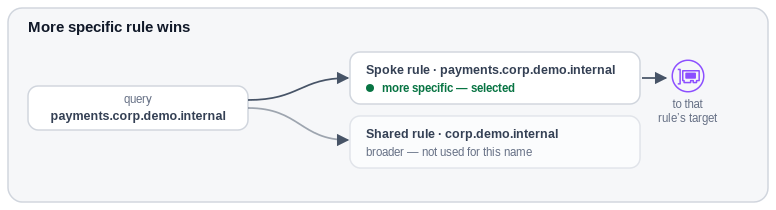
A more specific domain name in a spoke-owned rule wins over a broader shared rule. Example: a spoke rule for payments.corp.demo.internal overrides a shared rule for corp.demo.internal for that name. AWS routes a query that matches more than one rule using the most specific domain name.
That is the usual escape hatch: keep central for the broad zone, and give a critical account its own outbound + a tighter FORWARD rule so those names do not share the hub’s failure domain. Patterns covers when to use it: Escape hatch.
Demo BIND caveats
- Single EC2 instance, fixed private IP
10.0.0.10so target IPs survive replacement. - Production would use at least two DNS targets on the FORWARD rule.
- Zone
corp.demo.internaluses the reserved.internalTLD (avoids.localmDNS confusion). - Reverse zone
100.0.10.in-addr.arpacovers the synthetic A-record /24 (10.0.100.10/10.0.100.20). PTR queries need their own FORWARD rule — the forward-zone rule does not matchin-addr.arpa.